
by Omar Cruz | Aug 26, 2026 | Agent Value, Expired/Withdrawn/Cancelled, For Sellers, Selling Tips
Author- Keeping Current Matters
Few things are as rattling as the thought of your home sale falling through at the last minute, right before closing. All that waiting, all that progress, out the window.
But if you’re getting ready to sell, here’s what you should know. Even in today’s market, it rarely comes to that. Buyers who are moving at today’s rates and prices are generally moving because of some big life change. That means they’re motivated, and eager to get all the way to the closing table.
According to the latest data from Redfin, only about 1 in 7 pending sales are falling through. Meaning the vast majority make it all the way to closing.
And the single biggest thing that puts a deal at risk is the one you have the most power to prevent. It just takes a little smart planning before your house hits the market.
Why Some Deals Fall Apart Before Closing
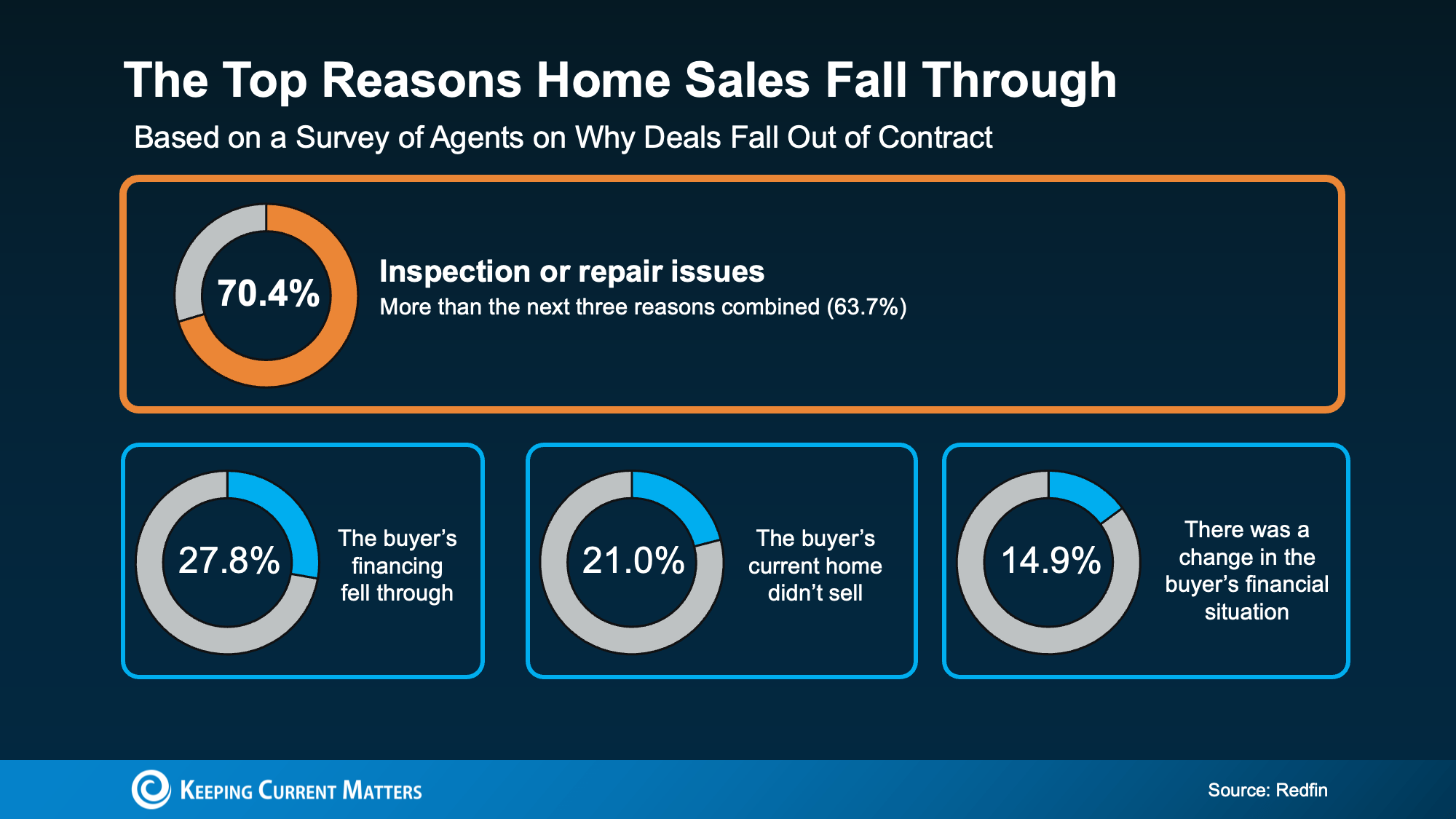
A Redfin survey sheds light on the most common things that trip up a sale (see visual below):
Here’s a bit more information on each one.
- Inspection or repair issues. This is the big one. When a buyer’s inspector finds a problem, whether with the roof, the plumbing, the foundation, or elsewhere, the buyer can push back, ask you to make repairs, request a credit so they can do it themselves, or see if you’ll lower your price. If they don’t get what they want, they may walk away from the deal altogether.
- The buyer’s financing fell through. Their mortgage loan has to be fully approved in time for closing day. If the loan doesn’t come together, the sale can’t move forward.
- The buyer’s current house didn’t sell. Some buyers need to sell their own home before they can close on yours. If that takes longer than expected, you may run into some issues with your timeline or even see them give up on their move.
- There was a change in buyer’s financial situation. A new job, a big purchase, or new debt can change what a buyer qualifies for on their mortgage loan, even after they were pre-approved.
Where Your Agent Makes the Difference
Some of those reasons are outside your control, like whether a buyer’s loan clears or whether they sell their own home in time. But according to Zillow, there are a few proactive things you can do to help make sure your sale goes as smoothly as possible:
- Save yourself the headache and get a pre-listing inspection. That’s when you get your own inspection before a buyer gets theirs. It lets you find the big issues before a buyer’s inspector does, so you can fix them or disclose them on your terms, instead of scrambling once you’re under contract. In this situation, your agent will help you decide what’s worth addressing and what to just disclose. Handle it now, and the biggest risk to your sale is behind you before a buyer ever brings it up.
- Look at more than just the offer price. Your agent will help you weigh the whole offer, including the buyer’s timeline and any contingencies attached. When a buyer’s offer depends on selling their own home first, the success of your sale rides on a second deal you can’t see. Sometimes, a slightly lower offer with fewer strings is the safer one. Your agent will help you weigh your options and make a plan that works well for you.
One of those is something you can’t do until you have offers in hand, but the other is something you can get ahead of right now. The pre-listing inspection.
That relatively small cost upfront can save you the much bigger hassle of a deal falling apart later. And while getting your own inspection before listing may not make sense in every market, your agent can tell you whether it’s worth it based on your market, your house, and what buyers are prioritize in your area.
Sometimes the smartest move is staying one step ahead.
Bottom Line
Most home sales still close, and the biggest thing that could get in the way of yours is the one thing you can actually do something about.
With the right prep, your sale has every reason to make it to the finish, and a good local agent can help you get there.

by Omar Cruz | Jul 1, 2026 | Agent Value, Expired/Withdrawn/Canceled, For Sellers, Selling Tips
Author: Keeping Current Matters
When your house doesn’t sell, it’s not just disappointing. It messes with your timing. Your plans. Your confidence. You start second-guessing everything, including the decision to move in the first place. And that raises 2 big questions:
Do you try again?
Is that even worth it?
Here’s the secret to getting a better outcome the second time around.
Different Agent. Different Results.
Most sellers who re-list and ultimately sell don’t wait for the market to magically change. They change their approach. And there’s data to back that up.
Research from REDX shows homeowners who put their house back on the market with a different agent are more likely to sell than homeowners who reused the same agent. Not to mention, they see their homes sell faster (see graph below):
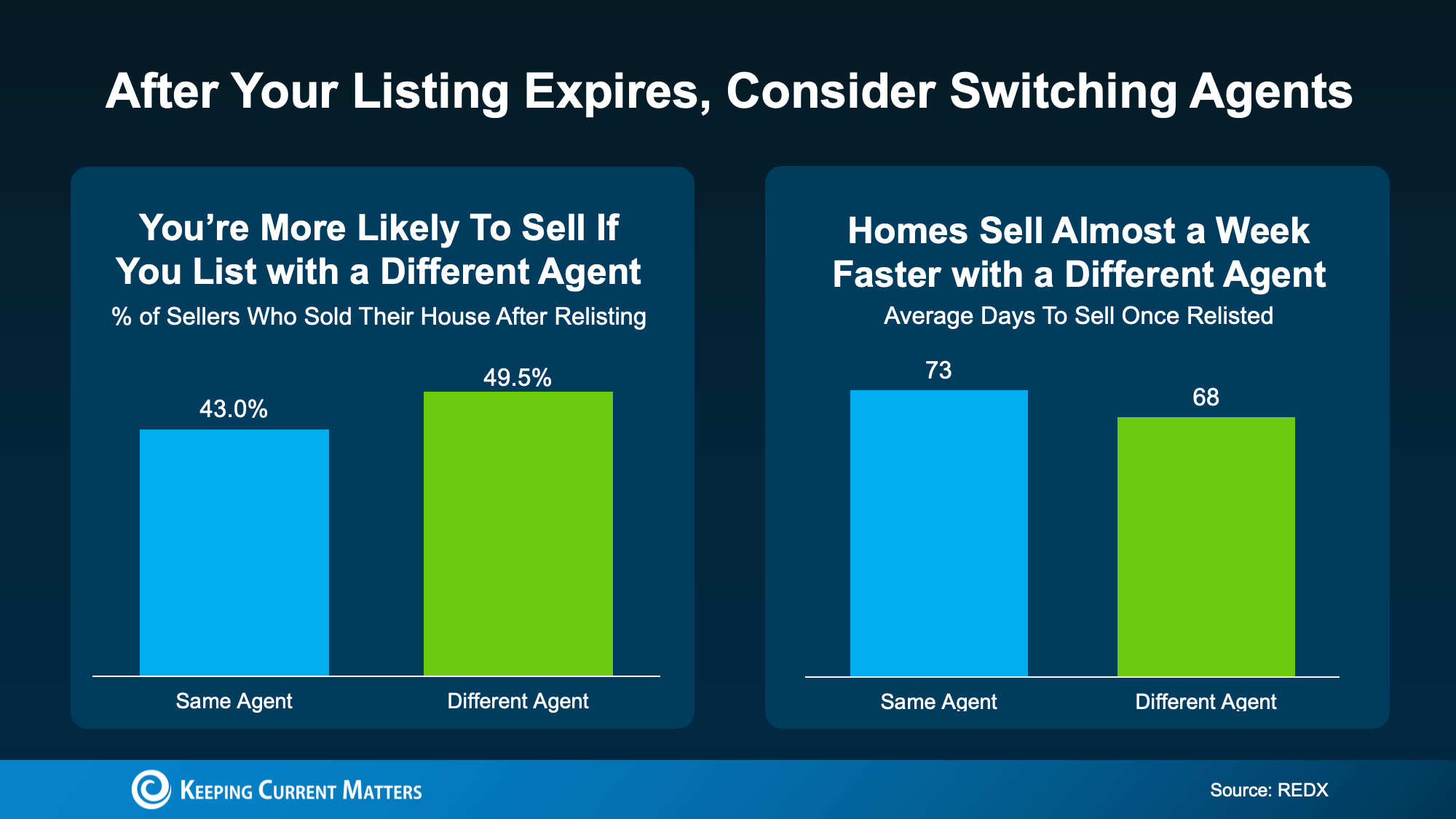
That’s the power of a fresh set of eyes. Because in a moment like this, the worst thing you can do is rerun the same set of plays and expect a different outcome. A different agent can bring a new perspective on where things went off track – and a lot of the time, one of these things happened.
1. The Asking Price Didn’t Match Buyer Reality
There’s a saying that’s especially important in today’s market, and it’s: “If your price isn’t compelling, it’s not selling.” Maybe that’s what happened with your house.
With mortgage rates where they are and inflation driving up the cost of everyday purchases, buyers have less room to stretch. If they feel like your house is priced even a little high, it’s going to get skipped over. And if no one looks at it, it’s not going to sell.
The Fix: Price to draw buyers in, not push them away. Have an agent pull fresh data from recent sales so your asking price matches what buyers are actually paying right now.
2. The First Impression Didn’t Win the Click
Most buyers decide whether they want to tour a home in seconds. If the photos look dark or dated, they scroll right past. And while you may think: “If they just saw it in person, they’d get it,” you may not get that chance.
And honestly, even in person, small things can quietly kill momentum – worn-down paint, outdated fixtures, clutter, or a yard that feels high-maintenance. Individually, they’re small. Stacked together, they create doubt.
The Fix: Walk the house like you’re a buyer, not the owner. Start with what’s easy and obvious – paint, lighting, curb appeal, decluttering. Then update the photos so they match the best version of your house.
3. The Marketing Was Too “Set It and Forget It”
Today, the number of homes for sale has grown in many areas. Buyers have more options, which means your house needs a plan to stand out. A generic description and a basic upload to the MLS can blend in fast.
The Fix: Find an agent who can build stronger exposure through digital marketing and social platforms, plus content that makes buyers stop – strong photos, a smart description, a video walk-through, and a plan for open houses and follow-up.
4. There Was No Clear Plan for Feedback
Sometimes the house gets showings, but no offers. If that was your experience, it actually tells you something important. Buyers liked it enough online to come see it. So, something else was holding them back.
Those buyers were sending a message. It just wasn’t translated into action.
The Fix: Make sure your agent has a clear plan for seeking out and acting on feedback quickly. That dialogue often points to the one change that would get a house sold.
5. The Deal Couldn’t Get Over the Finish Line
Even when a house is priced well and marketed right, deals fall apart when there’s no plan for the human side of the transaction.
Buyers today are more likely to ask for repairs, credits, or help with closing costs than a few years ago. In this type of market, being unwilling to negotiate can cost you more than a reasonable concession ever would.
The Fix: Decide ahead of time what matters most to you and where you can be flexible. Keep the dialogue open and lean on your agent for advice.
Bottom Line
If your house didn’t sell the first time, you’re not stuck. You just need a different strategy, and maybe a different partner.
When you’re ready for a fresh set of eyes on what happened and what to change first, connect with a local agent.

by Omar Cruz | Jun 17, 2026 | Affordability, Agent Value
Author: Keeping Current Matters
Whether you’re dreaming about buying your first home or wondering if it’s time to move on from the one you’re in, affordability is probably weighing on your mind. Home prices are still high in many markets, and even though things have improved a bit over the past year, making the numbers work can still feel like a stretch.
But the people finding ways to move right now usually have one thing in common. They didn’t wait for affordability to come to them. They went looking for it.
According to PODS, 61% of people across all generations say affordability is the biggest factor when deciding where to move. And it’s led a growing number of people to do one thing – broaden their search to include more affordable areas they hadn’t seriously considered before. As PODS, put it:
“. . . moving is increasingly driven by affordability, connection, and quality of life. As economic pressures persist, Americans are taking a more intentional, values-driven approach to where they choose to live.”
It’s Not Just the Home Price – It’s the Whole Cost of Living
Here’s where it gets really interesting. When people talk about moving for affordability, they’re not just talking about finding a cheaper house. They’re thinking about the full picture. What does it actually cost to live somewhere?
WalletHub looked at exactly this, measuring housing costs as a share of median monthly household income across every state (see map below).
Take a look at where you live on that map. The lighter the blue, the more affordable it generally is to live there. The darker the blue? Just the opposite.
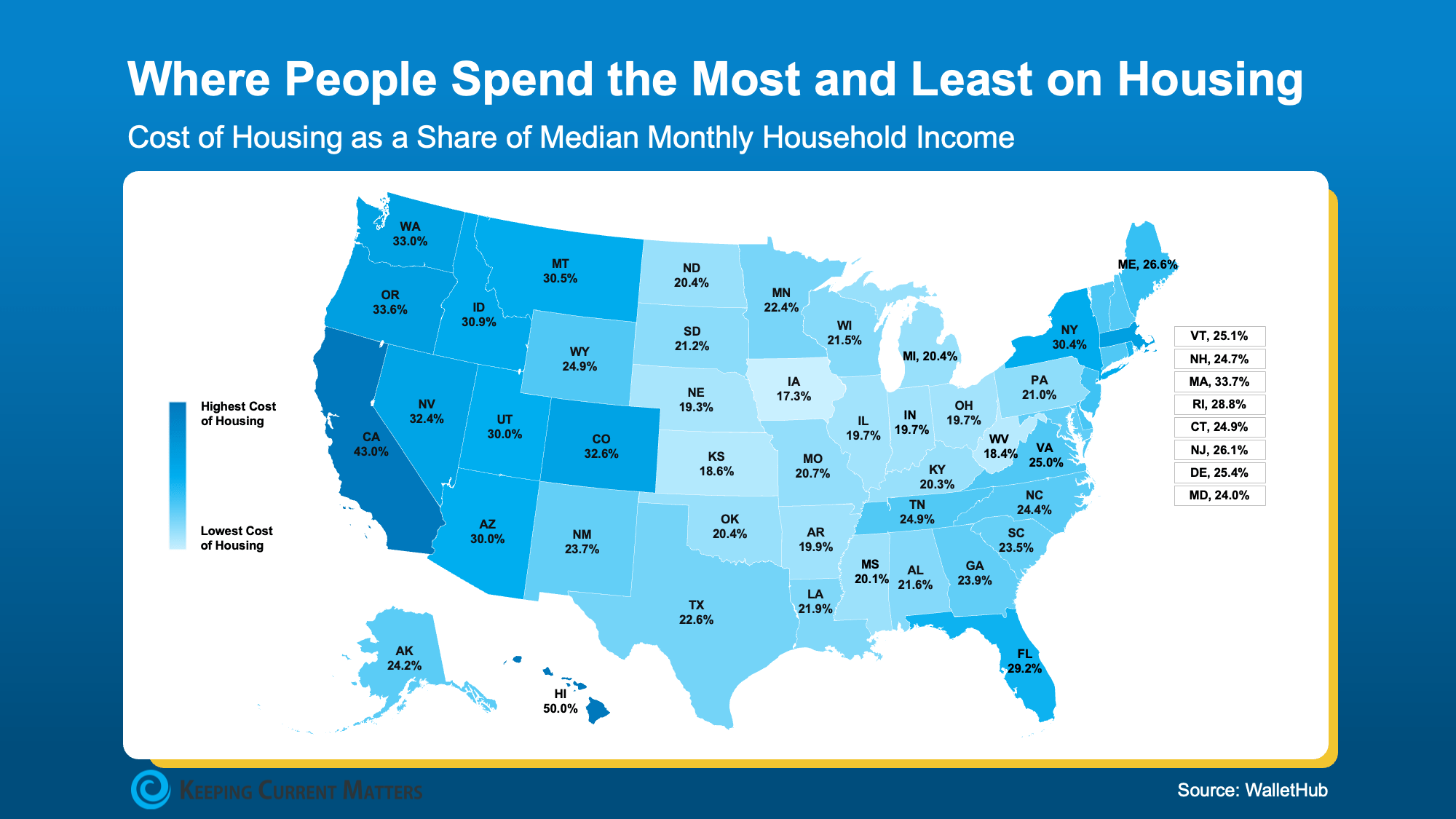
If your state is showing up on the darker blue end of the scale, the cost of living may be putting a real pinch on your wallet, and it may be worth exploring what a lighter-blue area could mean for your finances.
Because if you’re less financially stretched, imagine how that could change things. Less stress. Less worry. More freedom and peace of mind.
You Don’t Have To Move to Another State To Find a Better Deal
But finding more affordable homeownership doesn’t have to mean a cross-country move. It doesn’t even have to mean leaving your state, your family, or your favorite coffee shop behind.
Every market has more affordable pockets that most buyers never think to explore – neighborhoods, towns, and communities where home prices are lower, property taxes are more manageable, and the overall cost of living just works better.
A great local real estate agent knows exactly where those places are.
And if you work remotely, or have any flexibility in where you’re based, your options open up even further. Remote work has already changed the way millions of people think about where to live, and that trend isn’t going away.
When location stops being tied to a daily commute, a more affordable area that’s a bit farther out suddenly becomes a very real option.
Bottom Line
Affordability is a real challenge, but it’s not an unsolvable one. The key is being open to places you might not have considered before. A local real estate agent can help you find them.
Ready to find out which areas have the best affordability right now? Reach out today.

by Omar Cruz | May 12, 2026 | Agent Value, For Sellers, Selling Tips
Author: Keeping Current Matters
When you put your house on the market, you don’t just want it to sell. You want it to sell fast. But the thing is, nationally, it’s taking a little longer to sell lately. And that slowdown can feel frustrating if you want a fast process. Here’s what you need to realize.
In every market right now, there’s one clear exception:
Well-priced, well-presented homes are still selling, and it’s often faster than you’d expect.
If you can tap into that, you can still set yourself up to move quickly, too. Here’s how to get it done.
How Long Does It Take to Sell Today
According to Realtor.com, homes are selling in about 52 days right now. That’s how long the process takes from the day it hits the market until closing day.
And while that may sound slow to you, it’s not slow. It’s normal.
That’s because it’s pretty much right in line with what it was during the last normal years in the market (see 2018-2019 in the graph below):
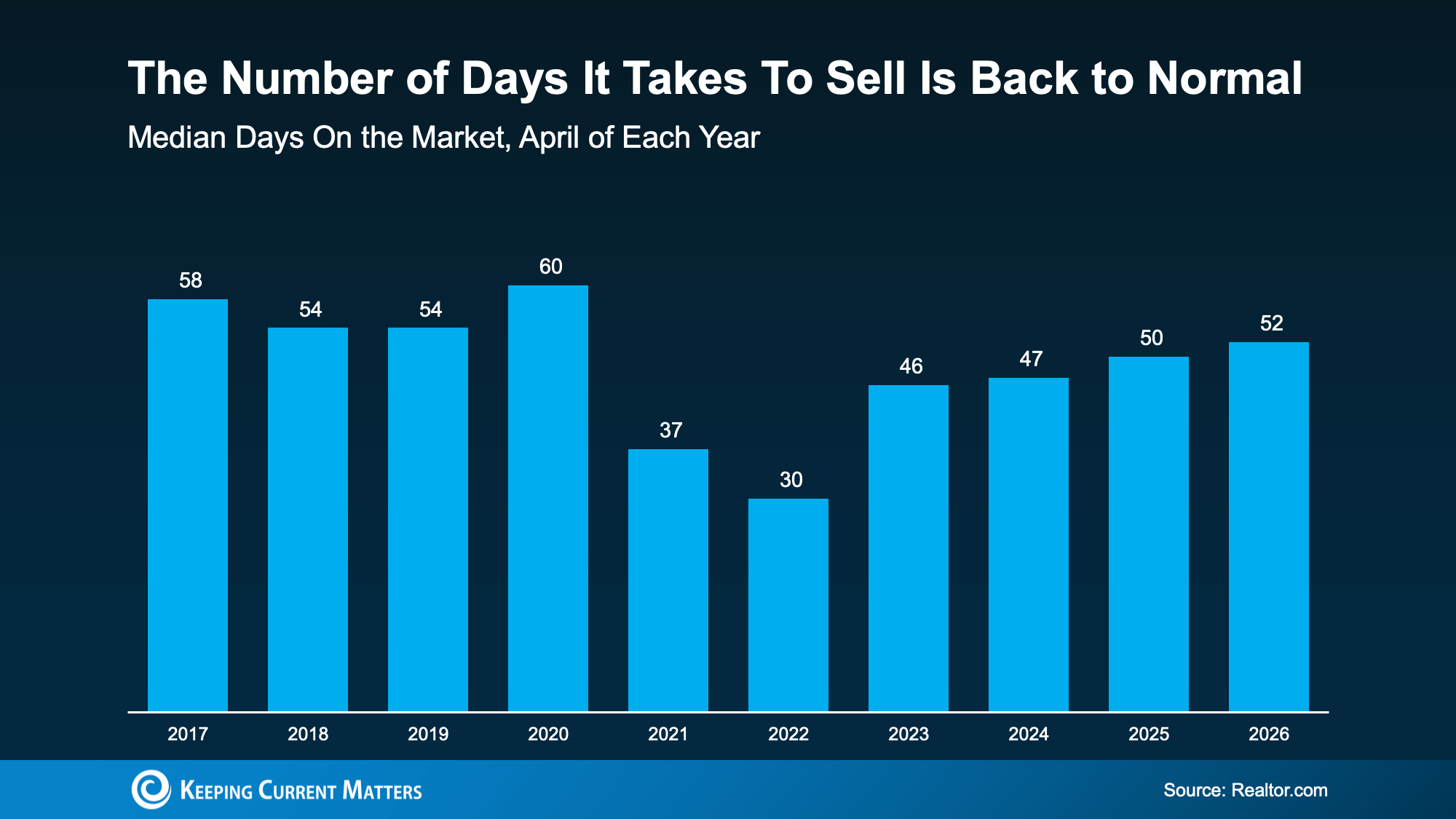 It just feels slow when you’re eager to move – or when you think back a few years to when homes seemed to sell almost instantly.
But here’s what matters most. The market is normalizing. Not at a standstill.
This is the norm for timing from start to finish. You may have an accepted offer in hand even faster than this.
Markets Where Homes Still Sell Quickly, Even Now
Zillow says the typical home will go “pending” or “under contract” in 19 days. Some homes even see it happen in as little as 7 days. It just depends on where you are – and how you prep your house.
So, don’t let the slowing pace of sales stress you out. Homes can still sell fast if they’re positioned right.
Just to show you, here’s a quick look at some of the markets that are moving faster than the norm, according to Zillow (see map below). This’ll show you how different it can be based on where you live.
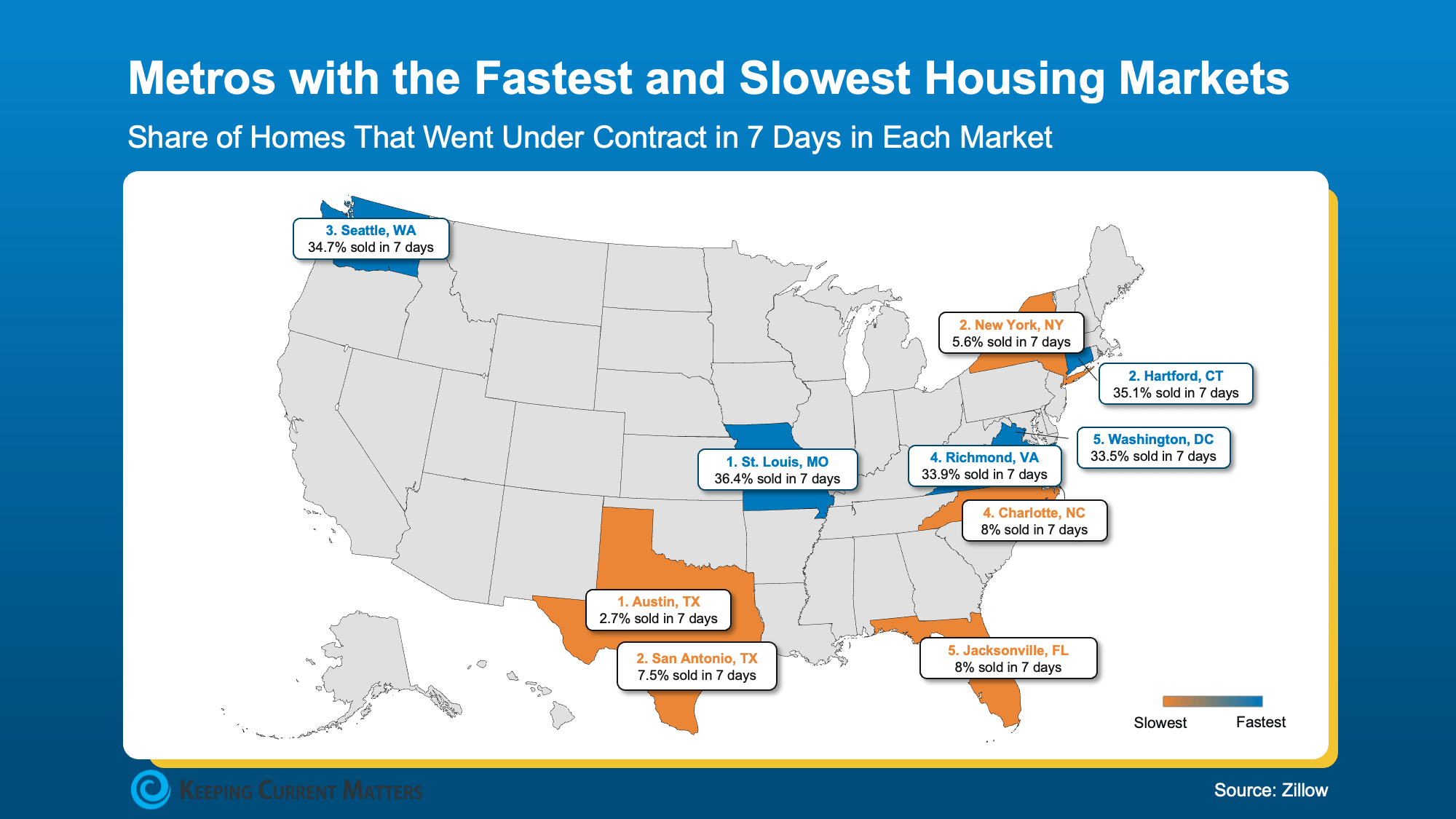 The key things you need to remember when looking at this visual:
- It varies a lot based on where you live. Within the same state, individual neighborhoods or pockets may sell much faster than the norm.
- Even in slower-moving states, you can still sell quickly. As the map shows, in those places, there are still homes that go under contract in as little as a week.
So don’t worry about if your state made either list. As Orphe Divounguy, Senior Economist at Zillow, says:
“The cream of the crop is still selling fast, even in markets that have slowed considerably. . .”
The Big Reasons Some Homes Sit, and Some Sell Fast
And here’s the big secret. While location can definitely play a role, it’s not just about location. It’s about strategy.
Today’s buyers are paying attention to condition. They’re comparing photos, upgrades, layout, location, and price. And they’re choosing homes that feel move-in ready and well worth the value.
The homes that check those boxes? They’re not sitting for long – no matter where they are.
As the Wall Street Journal (WSJ) explains:
“. . . some homes are still flying off the shelves. These houses are often in the Midwest or Northeast, where the lack of new construction keeps a lid on supply. Certain homes in other markets are selling quickly, too, often when a home is move-in ready.”
Because in any market – hot or not – if a home is overpriced, needs too much work, or just doesn’t meet current buyer expectations, it’s not going to sell.
In this market, the sellers who win are the ones who get real about their house. They’re honest about how their home compares to other listings, realistic about price, and they work with an agent who truly understands today’s market and what it takes to sell.
When your agent knows how to price strategically, spotlight the strengths of your home, and move quickly when the market gives clear signals, that’s when the results follow.
Bottom Line
Today’s housing market rewards the right strategy. Because even in a slower area, the homes that are priced realistically and positioned well are still selling – sometimes faster than you may expect.
Connect with a local agent if you’re ready to make yours one of them.

by Omar Cruz | Apr 30, 2026 | Agent Value, Downsize, For Sellers, Selling Tips, Senior Market
At some point, as you start thinking about the years ahead, this question tends to come up:
“Could I stay here long-term… or would it make more sense to move?”
It’s not always urgent. It often shows up in small moments, like going up and down the stairs, keeping up with the maintenance, or just thinking about what the next chapter of your life might look like in this home.
And for most people, the answer is simple. They want to stay.
The USC Leonard Davis School of Gerontology found that about 90% of adults over 65 prefer to stay in their homes as they get older (see below):
 But even if staying feels like the right answer, it’s still worth thinking ahead about what that might actually look like. That’s where the right agent can really help.
What You Need To Plan for If You’re Staying in Your Home
Aging in place is definitely possible. But it’s better if you have a plan. And here’s why. The home that once worked perfectly may need to change with you over the years. And it’s easier if you can anticipate those expenses.
- Sometimes that means small updates, like adding grab bars in the shower.
- Other times, you’ll have to make bigger decisions, like reworking layouts or moving key spaces to the first floor.
Some of those changes are going to be simple. Others can be a meaningful investment. And that’s why thinking about it early matters. Not because you need to decide anything right now, but because it gives you time.
- Time to understand what your home may need.
- Time to explore your options.
- Time to find the right contractors.
- Time to space out the expense of the upgrades.
According to ElderLife Financial, here’s a rough baseline of what it could cost depending on what needs to be done (see below):
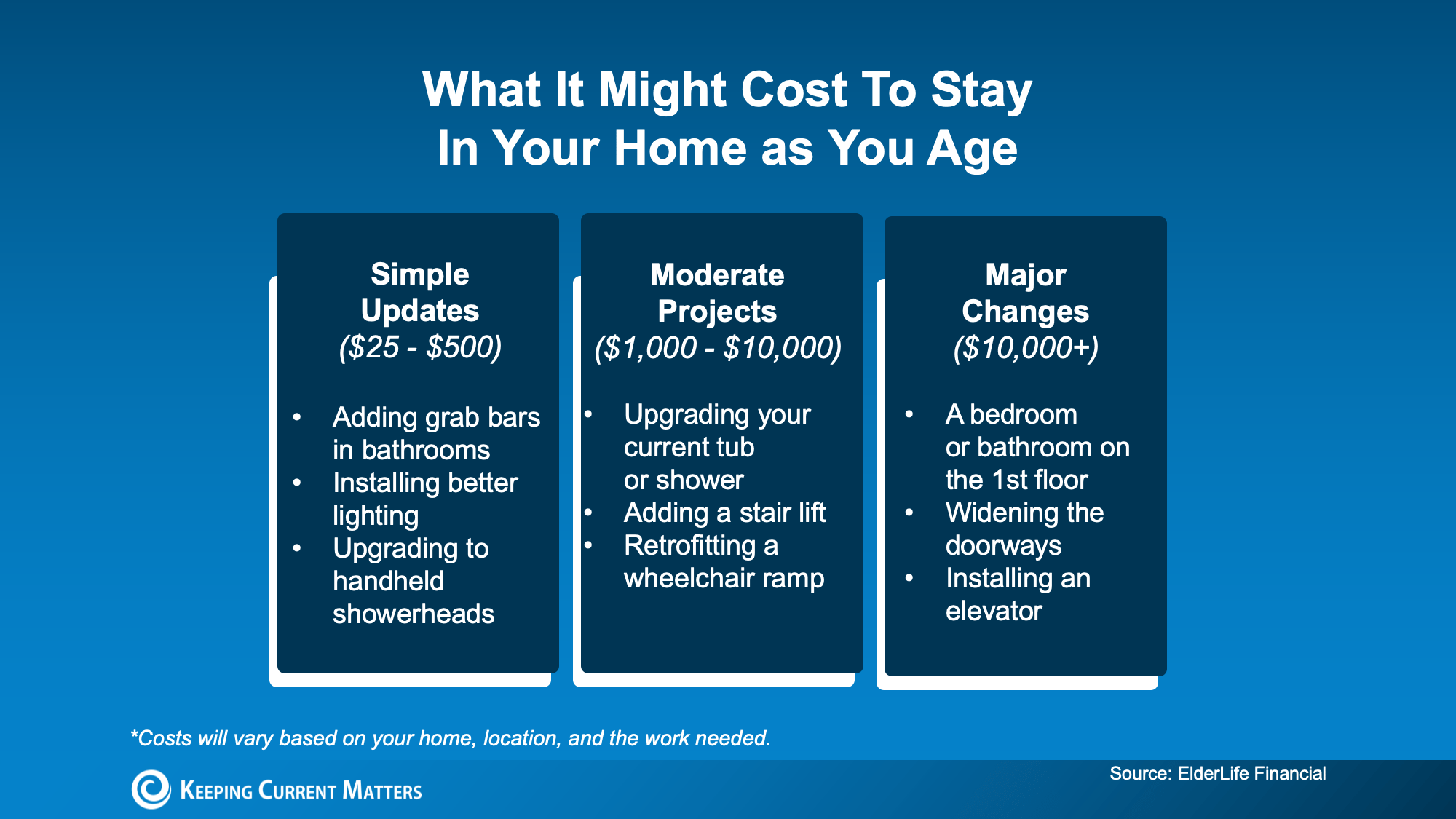 And don’t worry. If your heart is really set on staying, but the costs feel like a concern, it helps to know you have options. Depending on your situation, there may be financial assistance programs available, along with tools like home warranties to help manage unexpected costs.
Just remember, if you’re thinking about making updates, it’s always worth having a quick conversation before you start. A real estate agent can help you understand which changes tend to make sense for your situation and how they may impact your home’s value based on your local market.
When Moving Might Make More Sense
But staying isn’t always the best fit for every situation. According to Pegasus Senior Living:
“While most seniors hope to age in place, practical considerations sometimes make selling a home the wiser choice.”
Sometimes, it comes down to a simple shift: when the home that once made life easier starts to make it harder.
That might look like:
- Maintenance or yardwork that’s starting to feel overwhelming
- Stairs or layouts that are getting harder to manage day-to-day
- Or needing more support or care or being too far from loved ones
And sometimes, it’s not about necessity at all. It’s about lifestyle. Some homeowners just don’t want to live through major renovations. Others are ready to simplify, downsize, or move somewhere that better fits this next chapter, whether that’s a smaller home, a 55+ community, or a place closer to family.
For them, moving simply means making daily life easier.
Bottom Line
There’s no one-size-fits-all answer here.
Some people stay and make updates. Others move to simplify things. Either can be the right choice. The goal isn’t to pick one today. It’s to understand your options early, so when the time comes, you feel confident instead of rushed.
And if you ever want a sounding board to think through what the future could look like for you, a local real estate agent is there to help.

by Omar Cruz | Mar 27, 2026 | Agent Value, Featured, For Sellers, Selling Tips
You may have seen headlines on social saying the number of buyers backing out of their contracts is on the rise, and has recently reached a high not seen since 2017. That can sound intimidating. But it varies a lot by market.
And here’s the key thing to understand if you want to sell. A lot of the time, there’s one common cause. And it’s something you can actually control.
Here’s what you can do to get ahead of the biggest dealbreaker before it ever becomes a problem.
The Top Dealbreaker: Issues That Pop Up During the Inspection
A Redfin survey shows over 70% of recently cancelled contracts happened because of issues during the home inspection (see graph below):
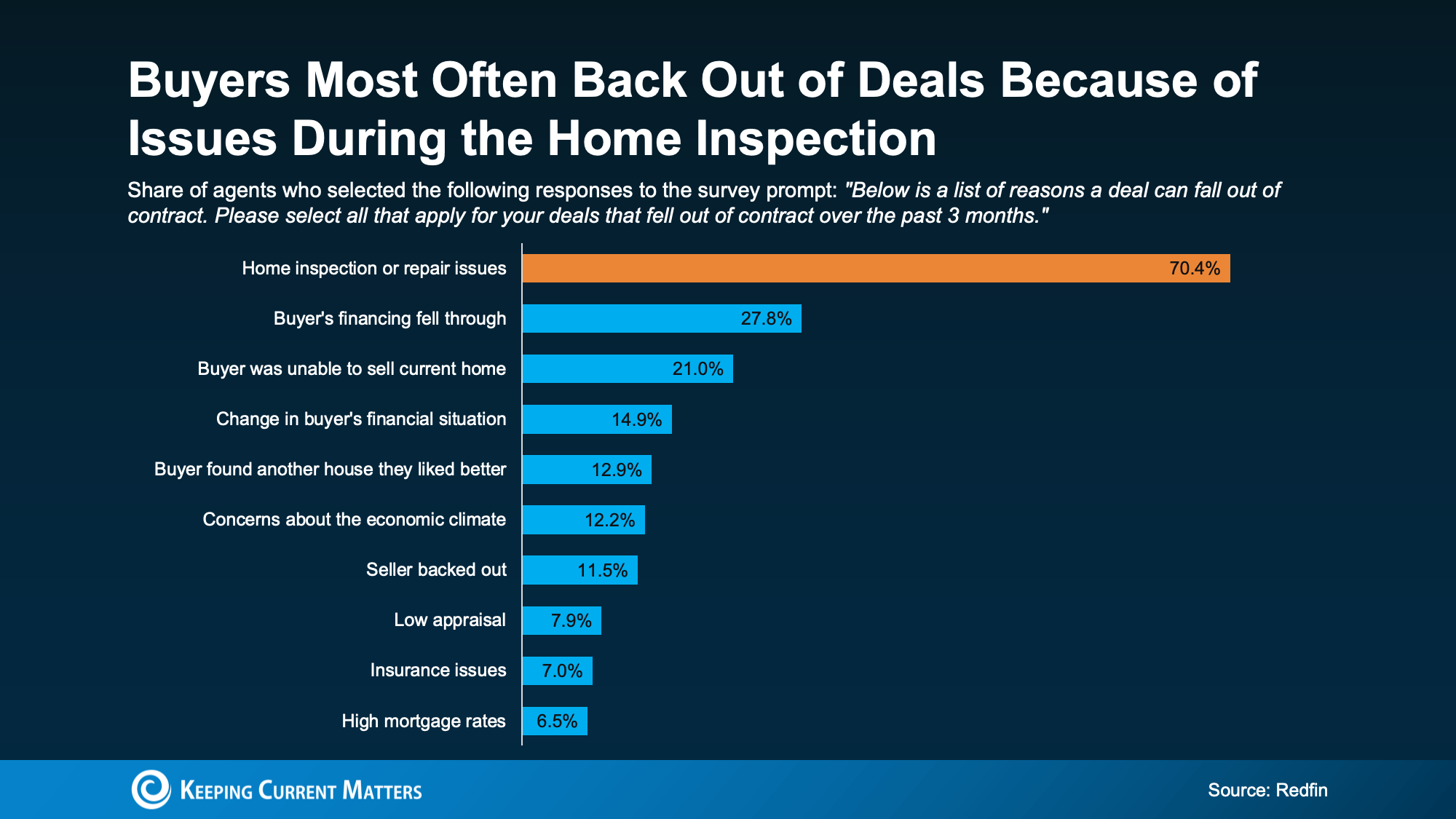 And that makes sense. Because today’s buyers have something they didn’t have a couple of years ago: options.
Why Fixing Things Before You List Matters More Today
A few years back, when buyers felt rushed or boxed in due to the limited number of homes for sale, they were more willing to overlook issues.
But in today’s market, skipping essential repairs is one of the fastest ways to lose a deal.
Now that there are more homes to choose from, buyers can be more selective. If a house feels risky, outdated, or like it’s hiding expensive surprises, they’re a lot more likely to walk away. So, what do you have to fix? Just ask an agent.
How Your Agent Can Help Give You the Edge
A local agent will be able to walk through your house and offer advice on what to tackle based on your specific home, your market, and what buyers are prioritizing in your area. They’ll also have first-hand knowledge about some of the biggest turnoffs for buyers today. And you can use that expertise to prevent future headaches.
For example, according to Zillow, these are some of the issues buyers will care the most about:
- Roof leaks or damage: sagging, leaking, etc.
- Plumbing problems: standing water, leaks, water damage, etc.
- Electrical concerns: outdated or exposed wiring, missing GFCI outlets, etc.
- HVAC issues: non-functioning units
- Pest or insect damage: termite colonies, etc.
- Hazardous materials: lead, mold, asbestos, etc.
- Safety/code violations: missing smoke detectors, windows stuck closed, etc.
- Structural problems: cracks in the foundation, sagging floors, etc.
Odds are, not all of this even applies to your house. Maybe only 1-2 things do. Or maybe none of them do. It just depends. But an agent will have the tools and resources to help you figure it out and stay one step ahead.
The Benefits of a Pre-Listing Inspection
To buyers, these aren’t cosmetic issues. They’re trust issues. And that’s what you need to watch out for today. Once buyers start wondering “what else might be wrong,” it’s hard to recover momentum.
That’s why some agents are even recommending a pre-listing inspection as a sneak peek into what buyers will see on their own inspection. With that insight, you can:
- Fix concerns before you list, or disclose issues upfront
- Avoid having to respond or negotiate under pressure
- Stop scrambling to find contractors with availability before your closing date
But remember, you don’t have to fix everything. You just have to be strategic about what you do tackle, so you and your buyer aren’t caught off guard.
And that’s why you need an agent who can:
- Decide if a pre-listing inspection is worth it where you live
- Recommend a trusted inspector (if you decide to get one)
- Look at the results with you to identify true dealbreakers in your market
- Help you decide what to fix or what to credit
- Make sure you avoid overspending or under-preparing
Bottom Line
One of the biggest dealbreakers for buyers today is inspection issues – and that’s something you can control. You just need to be proactive about high-impact repairs before you list.
If you want help figuring out where to focus, connect with an agent.
Author: Keeping Current Matters
